
The Marks We Leave: How Judgment Shapes a Child’s Self-Image and Identity
We hate being judged as adults… but we forget how easily we label children. The same words that hurt us today might be the ones we casually pass on tomorrow. The way we see our children today becomes the way they see themselves tomorrow.
7/24/20262 min read
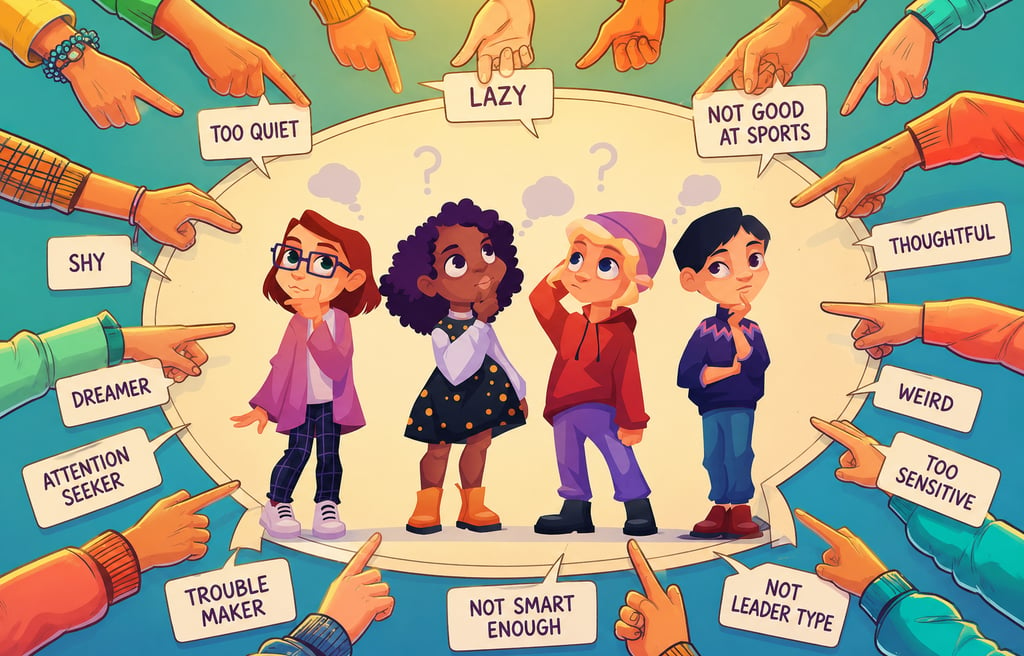
Labelling and judging are quiet but powerful forces shaping the human experience. Studies say around 70–80% of people feel judged almost daily, whether it’s in school, at work, social settings, or even at home. This perception often triggers:
lower self-esteem
increased anxiety and self-doubt
fixed self-concept and a closed mindset
increased sensitivity to criticism
trouble maintaining relationships and decision-making
reduced trust and openness
So, the labels—whether from others or the ones we stick on ourselves—can quietly mess with our confidence, our choices, and even how we see ourselves… usually leaning more toward “ugh” than “yay.”
We all know how much it hurts to be judged—yet, often without realizing it, we end up doing the same to others.
So how do we begin to change this?
A good starting point is curiosity. When possible, try to understand the other person’s story. Listening to their perspective not only deepens our understanding of them but also contributes to our own growth.
It also helps to pause and reflect inward. Could our reaction be shaped by our own insecurities or fears? Judgment often arises when we fixate on what we perceive as negative. Gently shifting our focus to notice positive qualities can soften this tendency.
Don’t Label the Seed Before It Grows
If we were to read the above through the lens of parenting—where “other people” becomes “our own children”—the message takes on an even deeper meaning.
Labels carry a powerful message. They confine a child to a particular role or behaviour. A child repeatedly called “bad” or “a trickster” may begin to see themselves that way, eventually living up—or down—to that label. Over time, they start to believe: this is who I am.
“It might help if we were to think of a child’s self-image as wet cement. Imagine that each of our responses to him leaves a mark and shapes his character.” – “Liberated Parents, Liberated Children” by Faber and Mazlish.
So, even seemingly positive labels such as “Princess,” “Champion,” “Beautiful,” or “Baby” can have unintended consequences. A “Princess” may resist responsibility, feeling it is beneath her. A “Champion” may struggle to accept setbacks or failure. These labels, too, shape expectations and self-perception in limiting ways.
“When we plant a rose seed in the earth, we notice that it is small, but we do not criticize it as rootless or stemless.”
This simple line by Timothy Gallaway, beautifully captures what we often forget with children. When we label them, we’re judging them at a moment in time, not recognizing who they are becoming. Just like the seed, they are in progress. Labels can quietly shrink a child’s confidence, making them believe they are the limitation we casually point out. But when we shift from labelling to noticing—spotting effort, curiosity, small growth—we send a very different message: you are capable, you are growing, you are more than this moment. Over time, this way of seeing them becomes the way they see themselves, shaping a stronger, more hopeful self-image that stays with them far beyond childhood.
Ultimately, when we become more aware of our tendency to judge—and choose instead to understand, reflect, and respond with intention—we not only grow as individuals, but also create a more compassionate space and a meaningful step towards shaping a more accepting world, for all of us to thrive.
Reach out to parentingkarma for guidance and support tailored to your family's needs.
parentingkarma@gmail.com
© 2026. All rights reserved.
Check out: